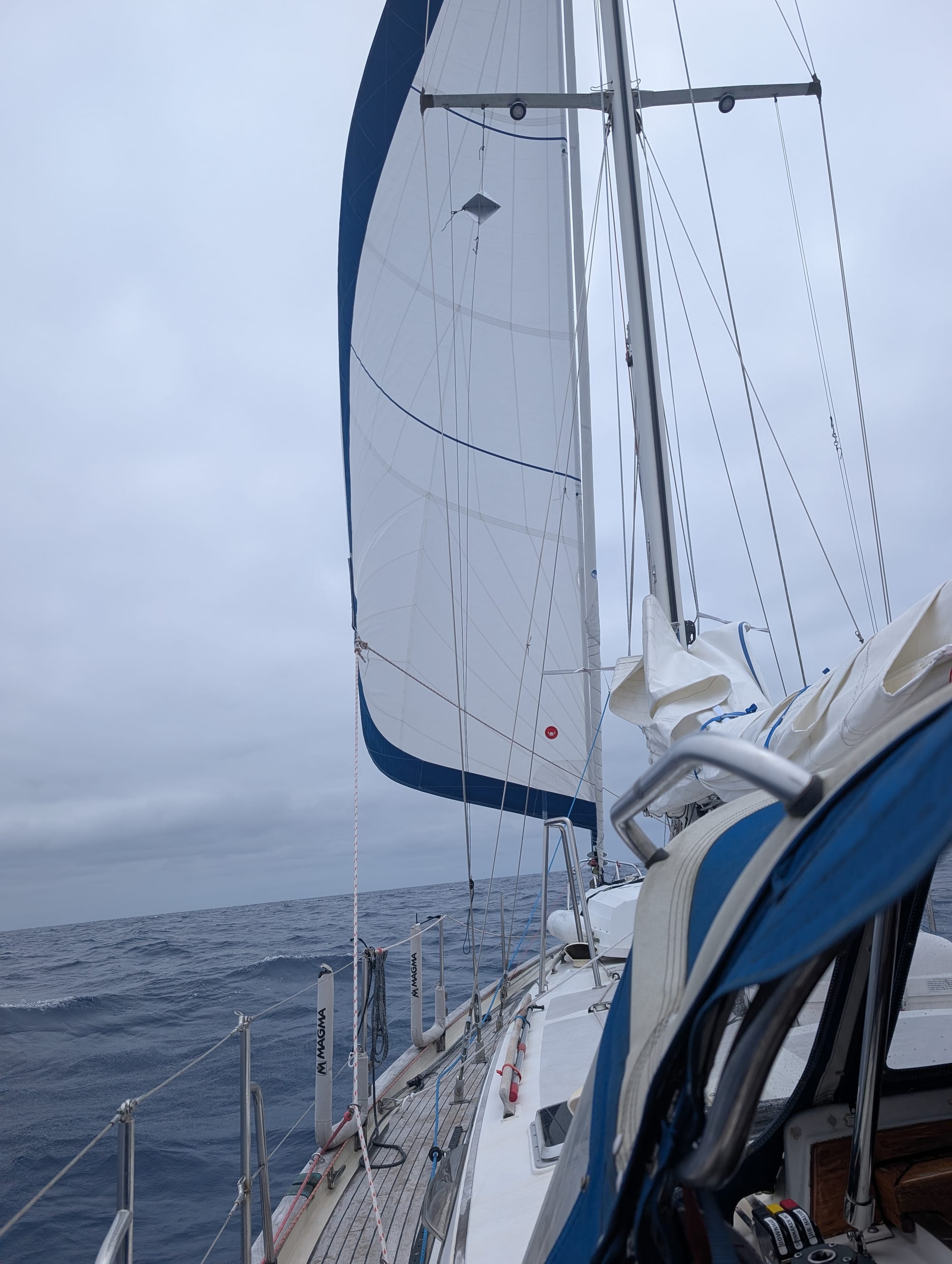
Bamfield to Hiva Oa: 39 Days, One Ocean, Still Married, just.

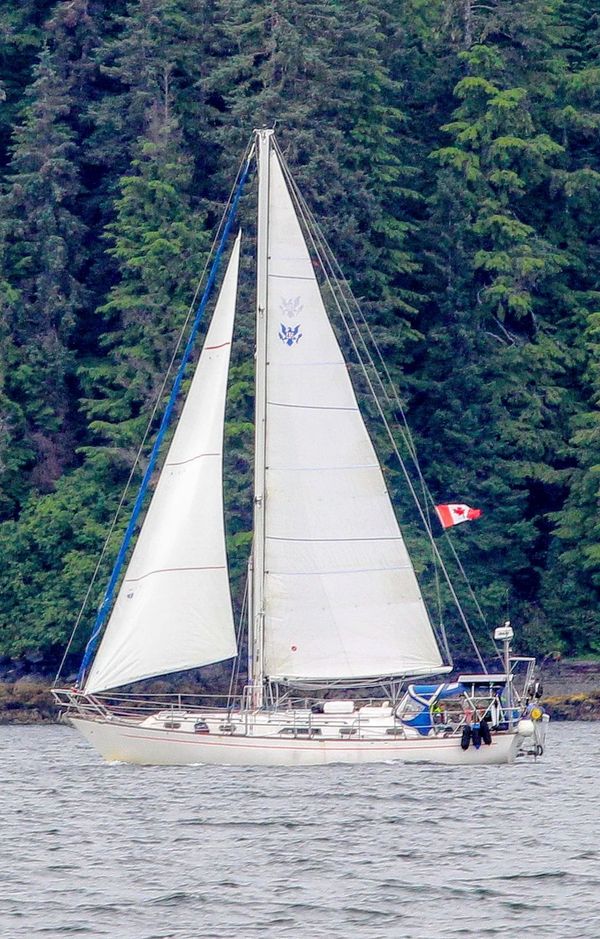
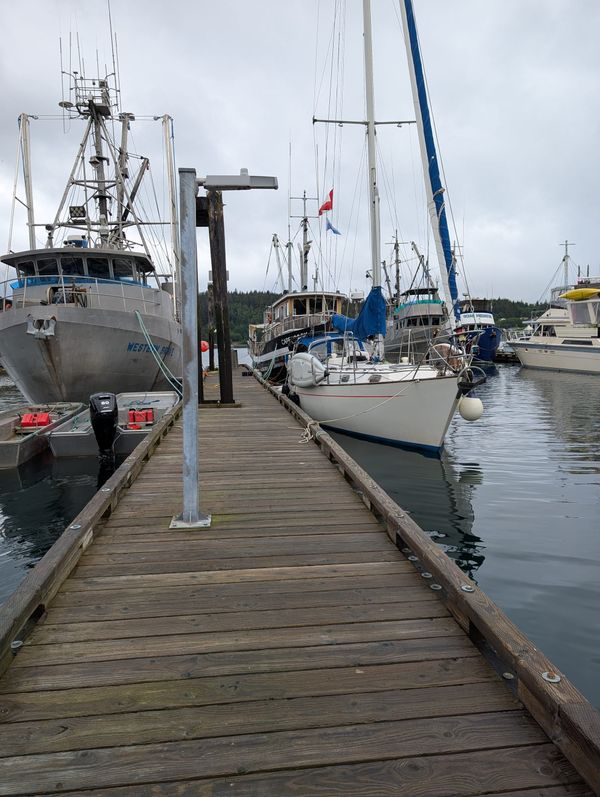
On May 30th we finally slipped out of Bamfield, waving goodbye to the Wreckage Pub and the last solid ground we'd stand on for over a month. Thirty-nine days later — a day less than Noah spent afloat, though thankfully with only two mouths to feed instead of every animal on Earth — we motored into the anchorage at Hiva Oa in the Marquesas Islands.
The short version: it was tough.
Longer version follows.

Spicy and bumpy leaving Bamfield — icy cold in the wind, bundled up for a departure that didn't feel like the tropics yet.
## The forecast lied
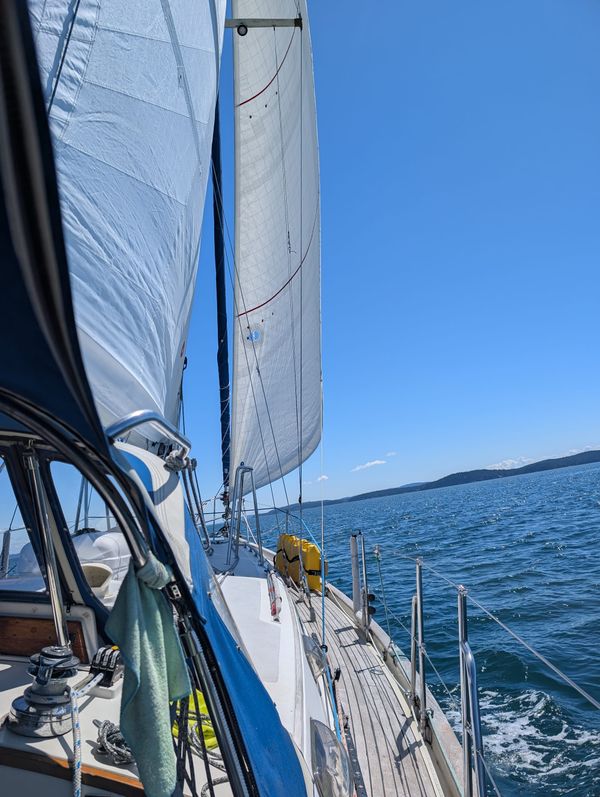
We'd read the books, watched the routing software, talked to everyone we could find who'd done a Pacific crossing before. Nothing quite prepared us for how consistently the weather undersold itself. Predict Wind would call for 12 knots and we'd get 20. It would call for a manageable sea state and we'd get a washing machine — waves coming from three directions at once, none of them agreeing on a plan. Early on we started calling it "STFPP": some thoughts for passage planning, a running series of notes we sent home as we figured out, in real time, what actually works out here versus what the guidebooks promise. We had maybe a handful of days of genuinely calm, pleasant sailing in the entire 39. The rest was a negotiation with a boat and a sea that rarely agreed on how fast we should be going. Push past about 5.5 knots and the motion became more than unpleasant — so more often than not we throttled back, reefed down, and accepted a slower, saner ride. Our daily average ended up closer to 100 nautical miles a day rather than the 120 we'd hoped for.

## The first week: still figuring it out
The first days out of Bamfield set the tone. Confused, popcorn-pattern seas — waves going in all directions at once — had us both feeling like we'd been thrown in a dryer. We hove to more than once just to get the boat, and ourselves, back under control. One night the wind vane's steering oar literally collapsed mid-watch; another night brought 25-knot squalls with zero visibility. We dropped and re-raised sails more times than either of us wanted to count, learning our own boat's limits the hard way, one gybe at a time. Sleep came in fragments. Four hours on watch, four off, and neither of us slept well through most of it — the boat's motion made sure of that. Meals shrank to whatever could survive being cooked, or not cooked, in a boat that wouldn't sit still: sandwiches, canned chicken salad, the occasional triumphant hot supper when the sea gave us a break.

## The middle: threading needles
As the days piled up we got better at reading the gaps between weather systems — threading a course between a windless zone to the west and an overpowering one to the east, again and again. Some days that worked beautifully: 130-mile runs with the wind vane steering itself and dolphins riding the bow wave. Other days we'd drift for hours in dead air, waiting for wind that the forecast swore was coming.

Night sailing became its own strange, beautiful ordeal — no moon, no stars, just the sound of water and wind and the boat finding its way through the dark. Then, without warning, the wind would howl in at 25 or 30 knots and it was all hands on deck to get sail down before it did any damage.

By the time we passed the Tropic of Cancer, we'd started to find something like a rhythm — better naps, warmer air, foul-weather gear finally packed away. It never lasted. Every stretch of calm was a down payment on the next stretch of chaos.


## Stowaways
Somewhere in the trades we picked up company. A booby decided the bow rail was prime real estate, groomed himself more thoroughly than either of us managed to, and stuck around for days. Eventually he brought a friend.

## The doldrums and the equator
The ITCZ — the Intertropical Convergence Zone, better known by its old sailor's name, the doldrums — lived up to its reputation both ways. Some days it meant glassy water and next to no wind, engine on, batteries charging, an odd sort of peace after weeks of being thrown around. Other days it meant torrential rain, squalls to 30 knots with no consistent direction, and a current shoving us backward while we fought for every mile south.


Crossing the equator should have been a celebration, and it was, briefly — right up until the wind piped up to 30 knots that same night and we were hove to again within hours. That was the crossing in miniature: every milestone paid for immediately by the ocean.


## The last stretch
South of the equator, the seas finally started to organize themselves into something resembling the trade-wind sailing we'd been promised the entire way. The miles ticked down — 320 to go, then 214, then 125 — and on the morning of July 7th, land appeared: Ua Huka first, then the silhouette of Hiva Oa itself against a Marquesan sunrise, the first land either of us had seen in a month.

Even the arrival wasn't simple. The anchorage was packed tight with boats. Our first attempt at setting the hook got fouled in an old submerged sail that killed the engine at the worst possible moment, leaving us drifting, powerless, in a crowded bay until it cleared itself. We got the anchor down, checked ourselves into French Polynesia on foot over hill and dale to a police station that had no record of our paperwork, and were both asleep by seven that evening.

## What it actually was
Thirty-nine days. Roughly 3,800 nautical miles. Two people, one boat, a wind vane named Hydro who did more of the actual steering than either of us. Conditions that were, almost without exception, more than what was forecast — more wind, bigger waves, less rest. We made it. We're still married. It was closer than we'd like to admit, not because of each other, but because of what an ocean can do to two people's patience, sleep, and sense of humor over five and a half weeks. Endless Song brought us through in one piece, and so, somehow, did we. Next stop: recovering, and then exploring the Marquesas Islands.